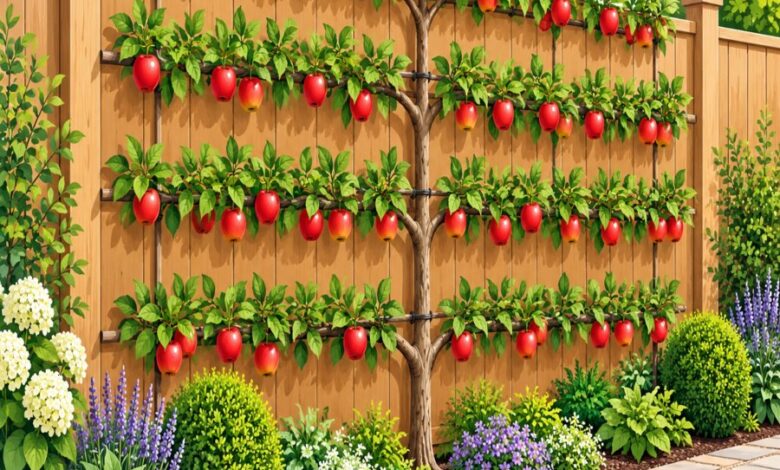
If you have been dreaming of a lush, productive orchard but your yard offers little more than a narrow strip along the property line, these espalier fruit tree secrets will completely change how you think about garden boundaries. Espalier is the centuries-old art of training fruit trees to grow flat against a wall, fence, or wire support, turning dead space into a living, fruit-bearing privacy screen. Mastering these espalier fruit tree secrets means you can grow apples, pears, and stone fruit in the tightest side yard without sacrificing an inch of your lawn for sprawling canopies.
In this guide, we will walk through everything from choosing the right rootstock to the exact pruning cuts that keep your trees flat, healthy, and productive for decades.
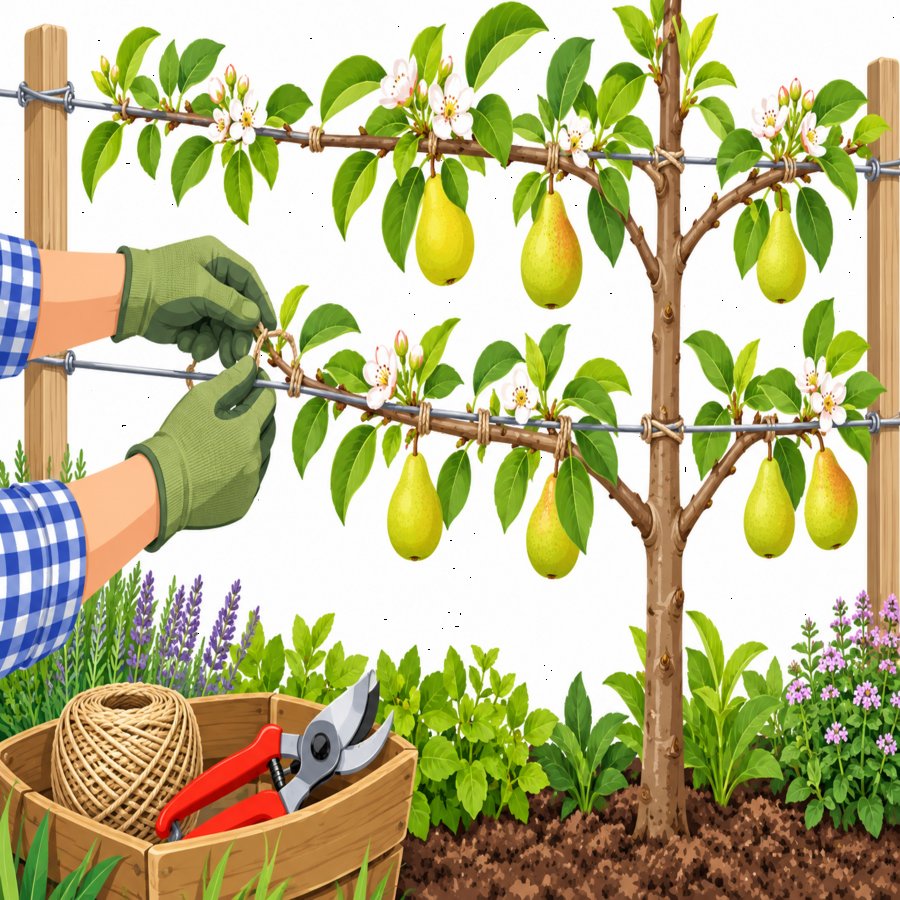
What Makes Espalier Fruit Tree Secrets So Valuable for Boundary Fences
A standard fruit tree can sprawl ten to fifteen feet in every direction, which is simply not realistic for most suburban boundary lines. Espalier training solves this problem entirely. By training branches horizontally or in decorative patterns along a two-dimensional plane, you create a tree that is essentially as flat as the fence it grows on.
This is one of the most practical espalier fruit tree secrets for anyone gardening in a small lot: a fence-trained tree occupies a footprint of less than two feet in depth, yet it can produce just as much fruit per linear foot as a conventional tree once mature.
Boundary fences also provide a unique microclimate advantage. Reflected heat and wind protection from a solid fence or wall can raise the local temperature by several degrees, which often translates into earlier blooming and sweeter, more reliably ripened fruit, especially in cooler climates where a few extra degrees make all the difference.
Choosing the Right Tree for Flat Wall Fruit Pruning
Not every fruit tree responds equally well to training, so selecting the correct species and rootstock is the foundation of successful flat wall fruit pruning. Apples and pears are the most forgiving and the most traditional choices because their flexible young wood bends easily without snapping.
Stone fruits like peaches, nectarines, and apricots can also be espaliered, though they typically require a fan-shaped pattern rather than strict horizontal tiers because their fruiting wood behaves differently than pome fruits.
Rootstock selection matters enormously. Always choose a dwarfing or semi-dwarfing rootstock such as M9, M26, or Quince A for pears, since vigorous standard rootstocks will constantly fight your pruning efforts and produce unmanageable growth spurts each season.
According to the Royal Horticultural Society, dwarfing rootstocks are essential for restricted forms like espalier because they naturally limit vigor, allowing the gardener to maintain shape with far less aggressive summer pruning.
Cordon Apple Training as a Beginner-Friendly Alternative
If a full multi-tiered espalier feels intimidating for your first attempt, cordon apple training is a wonderful entry point that still delivers the flat, fence-friendly profile you want.
A cordon is simply a single stem grown at a 45-degree angle along a wire, with short fruiting spurs pruned back each summer. Because there is only one main stem to manage, cordon apple training requires far less structural wire and far less patience before you see results.
The diagonal angle used in cordon apple training is not purely decorative. The 45-degree lean slows sap flow, which encourages the tree to put energy into fruiting spurs rather than aggressive vertical growth, making it an efficient technique for gardeners who want fruit quickly without constant rebalancing.
Multiple cordons can be planted just eighteen to thirty inches apart along a fence line, meaning a single ten-foot section of boundary fence could comfortably host four or five different apple varieties, each ripening at a different time for a staggered harvest all season long.
Step-by-Step Espalier Fruit Tree Secrets for Building Your Framework
Before planting, install a sturdy support system. Galvanized wires strung between vine eyes or anchored directly to fence posts should be spaced twelve to eighteen inches apart horizontally, giving each future tier a clear guide to follow.
Plant your young whip about four to six inches from the fence to allow airflow and future trunk thickening, then cut the central stem just above the first wire to force two side buds into growth.
This is the first of the real espalier fruit tree secrets: the two resulting shoots should be tied to canes set at a 45-degree angle rather than flat immediately. Training them at this gentler angle for the first season encourages even, vigorous growth on both sides before you lower them to full horizontal position the following winter.
Repeat this process at each successive wire tier, year after year, until you reach the desired height. Most home gardeners aim for three to four tiers, which typically takes four to five years to fully establish.
Patience during these formative years is the true test, and it is where many beginners quit too early, right before the structure would have rewarded them with its first serious harvest.
Seasonal Maintenance for a Thriving Small Garden Orchard
Once your framework is established, maintaining a small garden orchard along a fence becomes a matter of disciplined, regular summer pruning rather than heavy winter cuts.
In midsummer, shorten new side shoots growing from the main horizontal branches back to about three leaves beyond the basal cluster. This technique, sometimes called the Modified Lorette System, keeps the tree flat by redirecting energy into short fruiting spurs instead of long, wandering branches.
Feeding and mulching also differ from free-standing trees. Because espaliered roots are often confined to a narrower bed along the fence, apply a balanced, slow-release fertilizer in early spring and maintain a two-inch mulch layer to conserve moisture without smothering the shallow root zone.
The Old Farmer’s Almanac notes that consistent watering during fruit set is one of the most overlooked factors in orchard success, and this holds especially true for fence-trained trees, whose roots have less soil volume to draw from during dry spells.
Thinning fruit clusters down to one or two fruits per spur in late spring will also dramatically improve fruit size and prevent branches from sagging under an overloaded crop, a common issue in a densely packed small garden orchard.
Common Mistakes That Undermine Espalier Fruit Tree Secrets
Even experienced gardeners stumble on a few recurring pitfalls that quietly sabotage years of careful training.
Mistake one: tying branches too tightly. Rigid plastic ties or wire can girdle a growing branch within a single season. Always use soft, flexible garden tape and check ties every few months, loosening them as the trunk and branches thicken.
Mistake two: skipping summer pruning. Many gardeners only prune in winter, which encourages vigorous regrowth rather than fruiting spurs. One of the most important espalier fruit tree secrets is that summer pruning, not winter pruning, is what actually controls shape and promotes fruit production.
Mistake three: planting too close to a solid fence. Without adequate airflow, fungal diseases like apple scab and powdery mildew thrive in the humid pocket between tree and fence. Always maintain that four to six inch gap mentioned earlier.
Mistake four: ignoring pollination needs. Many apple and pear varieties require a compatible pollinator nearby. If your boundary fence has room for only one tree, choose a self-fertile variety or confirm a neighboring pollinator exists within bee-flying distance.
Design Ideas to Blend Function and Beauty Along Your Fence
Beyond the harvest itself, a well-trained fence orchard is a genuine landscape feature. Classic tiered espaliers create a living lattice effect that looks striking in spring bloom and again in autumn when fruit hangs along neat horizontal rows.
For a more ornamental twist, consider a Belgian fence pattern, where multiple cordons are trained diagonally in opposing directions to form a diamond lattice. This design works beautifully as a living privacy screen that doubles as a productive hedge between you and a neighboring yard.
Pairing your orchard with smart storage solutions nearby makes the whole space more functional. If you need a tidy spot to store pruning tools, twine, and garden gloves close to your fence line, repurposing indoor furniture for outdoor-adjacent storage can be surprisingly effective; this guide on creative IKEA Billy bookcase garden storage conversions shows how to transform an affordable bookcase into weatherproof shelving for exactly this purpose.
Underplanting the base of each tree with shallow-rooted herbs like chives or thyme also adds visual texture while suppressing weeds, keeping the whole fence line looking intentional and polished year-round.
Harvest Timing and Long-Term Rewards
A well-maintained fence orchard typically begins producing meaningful quantities of fruit in its third or fourth year, with full production arriving by year six or seven.
Patience pays dividends here. A mature four-tier espalier apple can yield twenty to thirty pounds of fruit annually from a footprint smaller than a parked bicycle, an efficiency ratio that free-standing trees simply cannot match in small yards.
Resources from the USDA on regional hardiness zones are worth consulting before final variety selection, ensuring the cultivars you choose will reliably set fruit in your specific climate and frost window.
Ultimately, these espalier fruit tree secrets transform an ordinary boundary fence into one of the most productive and beautiful features of the entire garden, proving that even the smallest lot has room for a genuine, fruitful orchard.