If you have ever dug through a chaotic drawer searching for cumin while your onions burned on the stove, you already understand why good spice drawer organization ideas matter so much. A cluttered spice drawer does not just waste time, it actively works against you in the middle of cooking, when speed and precision count the most. The good news is that transforming that drawer from a jumbled mess into a streamlined, chef-worthy system does not require a full kitchen renovation or a big budget.
With a handful of smart strategies, the right storage tools, and a little patience, you can build a spice station that saves you real minutes every single night. This guide walks through six practical, tested approaches to organizing your spice drawer so that every jar, tin, and packet has a home. Whether you are working with a shallow drawer, a deep drawer, or no drawer at all, there is a strategy here that fits your kitchen.
Why Smart Spice Drawer Organization Ideas Save You Real Cooking Time
Before diving into specific systems, it helps to understand why disorganized spices cost you so much time in the kitchen. Studies on workflow efficiency consistently show that search time, not actual task time, eats up the biggest chunk of a cook’s prep window.
When you are hunting for smoked paprika among twenty unlabeled bottles, you are not cooking, you are searching. Multiply that by every recipe, every week, and the minutes add up to hours of lost time over a year.
The Hidden Cost of Clutter
Beyond lost time, a disorganized drawer also leads to duplicate purchases. Most home cooks admit they have bought a spice they already owned simply because they could not find it.
That duplication wastes money and pantry space, and it often means older spices lose potency sitting forgotten in the back. Thoughtful spice drawer organization ideas solve both problems at once by giving every item visibility and a permanent spot.
According to guidance from Better Homes & Gardens, grouping kitchen tools and ingredients by frequency of use is one of the simplest ways to speed up everyday cooking tasks. The same logic applies directly to spice storage.
Idea One: Install Tiered Spice Racks for Instant Visibility
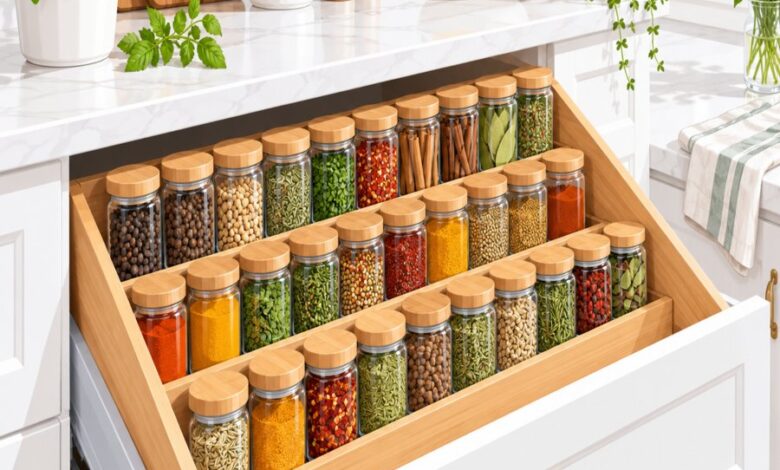
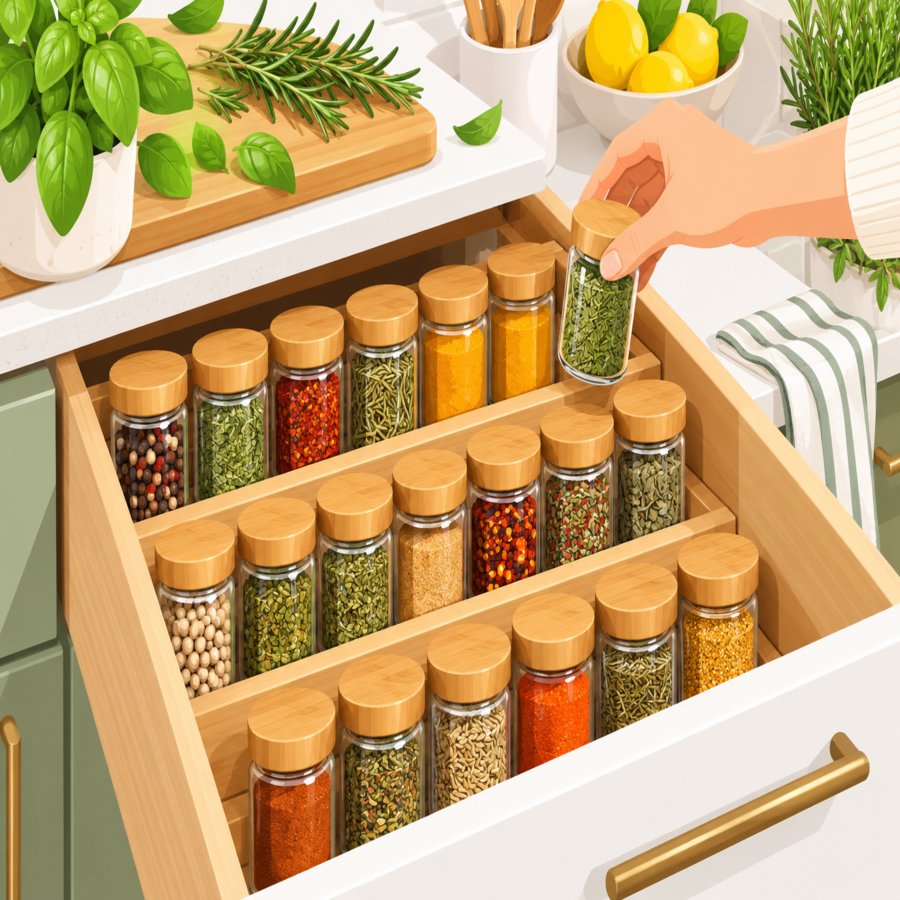
The single most transformative upgrade for a shallow or deep drawer is adding tiered spice racks. These step-style inserts lift the back row of jars higher than the front row, so every label is visible at a glance instead of hidden behind taller bottles.
Tiered spice racks work beautifully in drawers because they maximize vertical space that would otherwise go unused. Rather than stacking jars on top of each other and losing track of what is underneath, you create clear rows that fan out toward you when the drawer opens.
Choosing the Right Tier Height
Measure your drawer depth before buying. A standard kitchen drawer runs between three and five inches deep, so look for tiered inserts designed specifically for drawer use rather than cabinet shelving.
Expandable bamboo or acrylic tiers are excellent because they adjust to fit drawers of different widths. This flexibility means the same rack can move with you if you ever update your kitchen layout or try one of the budget-friendly affordable kitchen upgrades that boost everyday function many homeowners use to modernize their space without a full remodel.
Once installed, tiered spice racks instantly become one of the most effective spice drawer organization ideas because they solve the visibility problem at its root. You simply look down and scan, rather than lifting jars one by one.
Idea Two: Switch to Uniform Spice Jars for a Clean, Scannable Grid
Mismatched spice containers are one of the biggest culprits behind a chaotic-looking drawer. Tall jars, squat tins, and crinkled paper packets of various brands all compete for space and make scanning difficult.
Switching to uniform spice jars eliminates this visual noise entirely. When every container shares the same shape, height, and lid style, your drawer transforms into an orderly grid that your eyes can scan in seconds rather than minutes.
Glass Versus Plastic
Glass jars are the preferred choice for most home cooks because they resist staining, do not absorb odors, and keep spices visually fresh. Square or hexagonal glass jars also nest together more efficiently than round ones, squeezing more storage into the same drawer footprint.
Plastic uniform jars are a lighter, budget-friendly alternative, particularly useful for households with young children or anyone worried about breakage near a stove area. Either material delivers the same core benefit: a tidy, repeatable shape that stacks and slots predictably.
When shopping, buy a few extra jars beyond your current spice count. New spices and seasoning blends have a way of multiplying, and having backups on hand keeps your system from falling apart the moment you bring home a new ingredient.
Idea Three: Commit to Labeled Spice Storage for Zero Guesswork
Uniform jars look stunning, but without labels they create a new problem: everything looks identical from the top. Labeled spice storage is the step that ties the whole system together and makes it genuinely functional, not just photogenic.
Lid labels are essential for drawer storage specifically, since you are looking down at the tops of jars rather than at their sides the way you would on a shelf. A small circular label on the lid lets you identify a spice instantly without lifting a single jar.
Printed Versus Handwritten Labels
A label maker produces crisp, uniform text that reads easily even in dim kitchen lighting, and it reinforces the clean aesthetic of your uniform jars. Chalkboard-style labels paired with a fine-tip marker offer a warmer, more rustic look and the flexibility to relabel instantly when you switch spices.
Whichever style you choose, consistency matters more than the method. Mixing label styles throughout the drawer recreates the same visual clutter you were trying to eliminate in the first place.
Consider adding the purchase date to each label as well. This small habit helps you track freshness, since ground spices generally lose potency after about a year, a detail echoed in several storage guides from The Old Farmer’s Almanac on preserving kitchen ingredients.
Idea Four: Organize by Cooking Frequency, Not Alphabetically
Alphabetical order feels intuitive, but it rarely matches how you actually cook. Salt, pepper, garlic powder, and cumin get used almost daily, while items like saffron or star anise might appear once every few months.
Instead, organize your drawer by frequency of use. Place your five or six most-used spices in the front row, closest to where your hand naturally lands when you open the drawer.
Creating Zones Within the Drawer
Within that frequency-based layout, you can further divide the drawer into flavor zones, such as a baking zone with cinnamon, nutmeg, and vanilla, and a savory zone with oregano, thyme, and chili powder. This mental mapping speeds up recipe prep because you already know which corner of the drawer to reach into.
This approach is one of the most personalized spice drawer organization ideas available, since your zones should reflect your actual cooking habits rather than someone else’s recipe collection. A household that bakes often will build a very different map than one that cooks primarily Mexican or Indian cuisine.
Revisit your zones every few months. Cooking habits shift with the seasons, and a drawer optimized for summer grilling spices may need rearranging once soup season arrives.
Idea Five: Use Drawer Dividers for Bags, Tins, and Oversized Containers
Not every seasoning fits neatly into a small jar. Bulk bags of specialty salts, tins of curry powder, and oversized bouillon containers all need a home too, and drawer dividers are the answer.
Adjustable drawer dividers create separate compartments within a single drawer, so bulky items stay upright and contained instead of sliding around and crushing smaller jars. Clear acrylic dividers work especially well because they do not block your view of labels.
Repurposing Unexpected Items as Dividers
Small bamboo trays, silverware organizer trays, or even repurposed shoeboxes trimmed to size can function as makeshift dividers if you are testing a layout before committing to a purchase. This is a smart, low-cost way to prototype your system.
Once you know exactly how many compartments you need and in what sizes, invest in a proper divider set. The structure keeps your drawer looking intentional rather than improvised, and it prevents the slow creep back toward clutter that happens when containers are free to shift every time the drawer opens and closes.
Dividers also make cleaning dramatically easier. Spilled spice dust stays contained within one compartment instead of coating the entire drawer bottom.
Idea Six: Build a Backup Inventory List to Prevent Overbuying
A beautifully organized drawer loses its value fast if you keep buying duplicate spices at the grocery store. A simple running inventory list solves this permanently and rounds out your spice drawer organization ideas with an ongoing maintenance habit.
Tape a small notepad inside a nearby cabinet door, or keep a shared note on your phone, listing every spice you own along with roughly how full each jar is. Update it whenever you notice a jar running low.
Pairing Inventory With Refill Stations
If you buy spices in bulk from a refill store, keep your uniform jars and a small funnel together in one spot. This makes restocking a thirty-second task rather than a chore you keep postponing.
The USDA notes that proper labeling and inventory tracking in food storage reduces waste significantly, a principle that applies just as well to a home spice drawer as it does to a commercial pantry. Reducing waste also means reducing unnecessary trips to restock items you already had.
Once your inventory habit is in place, the entire system becomes self-sustaining. You will rarely buy a duplicate again, and your drawer will stay organized far longer than a one-time cleanup ever could.
Putting All Six Spice Drawer Organization Ideas Together
Each of these strategies works well on its own, but the real transformation happens when you layer them together. Start with tiered spice racks to maximize visibility, then fill them with uniform spice jars for a clean, scannable grid.
Add labeled spice storage so nothing gets misidentified, arrange everything by cooking frequency instead of the alphabet, use dividers for bulkier items, and finish with an inventory habit that keeps the whole system humming for years.
A Realistic Weekend Plan
You do not need to tackle everything in one afternoon. Dedicate one weekend day to emptying the drawer completely, sorting spices by freshness, and measuring for racks or dividers.
Order your jars and racks, then spend a second shorter session transferring spices, labeling jars, and arranging your frequency zones. Spreading the project over two sessions keeps it manageable and prevents the half-finished drawer syndrome so many organization projects fall victim to.
The Royal Horticultural Society often emphasizes that good storage habits in the garden shed translate directly to good habits in the kitchen, since both spaces reward the same principles of grouping, labeling, and regular upkeep. A spice drawer, like a tool shed, stays functional only when everything has a designated place.
Once your system is in place, maintenance takes only seconds. A quick wipe-down during your weekly kitchen clean and the occasional relabeling when a spice runs out are all it takes to keep your drawer performing at its best.
In the end, the time you invest upfront in these six spice drawer organization ideas pays you back every single time you cook. Dinner comes together faster, recipes feel less stressful, and your kitchen starts to feel like a space that works for you instead of against you.